
Architecture
The diagram shows the target single-node architecture, not a list of completed features.
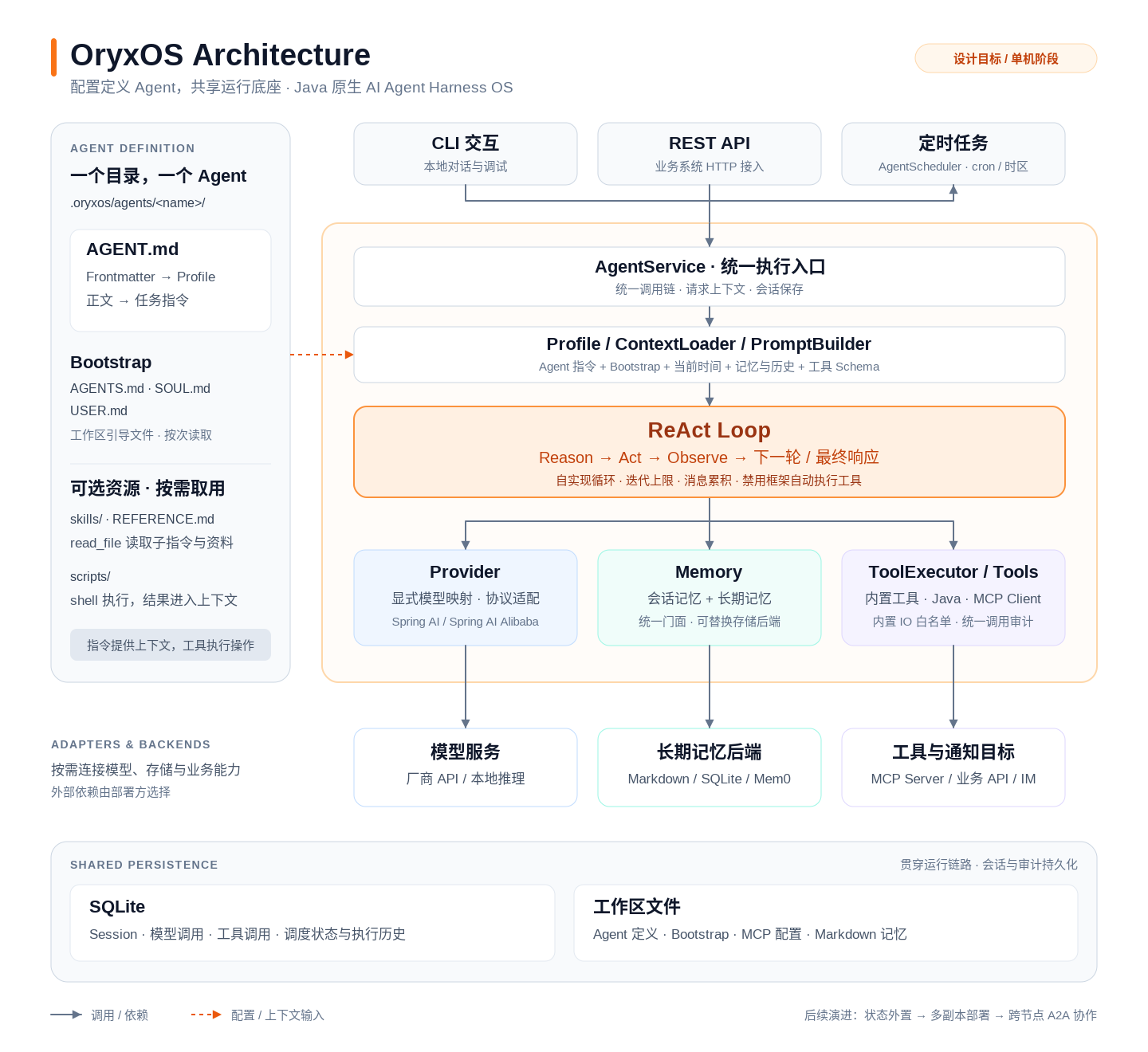
One engine, three entry points
CLI, REST, and the scheduler call AgentService. The service owns request context and persistence, while ReActLoop coordinates model calls, memory, and tool execution.
AgentLoader derives a Profile from an Agent directory. ContextLoader and PromptBuilder assemble instructions, Bootstrap files, the current time, memory, recent messages, and tool schemas.
Runtime boundaries
| Component | Responsibility |
|---|---|
| Provider | Explicit provider-name-to-model mapping and protocol adaptation |
| ReAct | Reason → act → observe, message accumulation, iteration limits |
| Memory | Unified access to session history and long-term stores |
| Tool | Built-in, Java, and MCP tools through one execution contract |
| Storage | Sessions, model/tool audit, and scheduler state |
Spring AI automatic tool execution stays disabled. OryxOS controls scheduling and execution to prevent duplicate tool calls.
Storage and safety
SQLite is the baseline for sessions and audit. Long-term memory has Markdown, SQLite, and self-hosted Mem0 adapters in the design. Agent definitions and editable context remain in the workspace.
Application-level path, command, and domain allowlists are the initial guardrails. They are not container isolation. A script may make its own network requests; running a script-bearing Agent requires trust in its author.
Nine modules
oryxos-core, oryxos-provider, oryxos-memory, oryxos-tool, oryxos-channel-cli, oryxos-web, oryxos-storage, oryxos-cli, and oryxos-boot form the initial Maven structure.